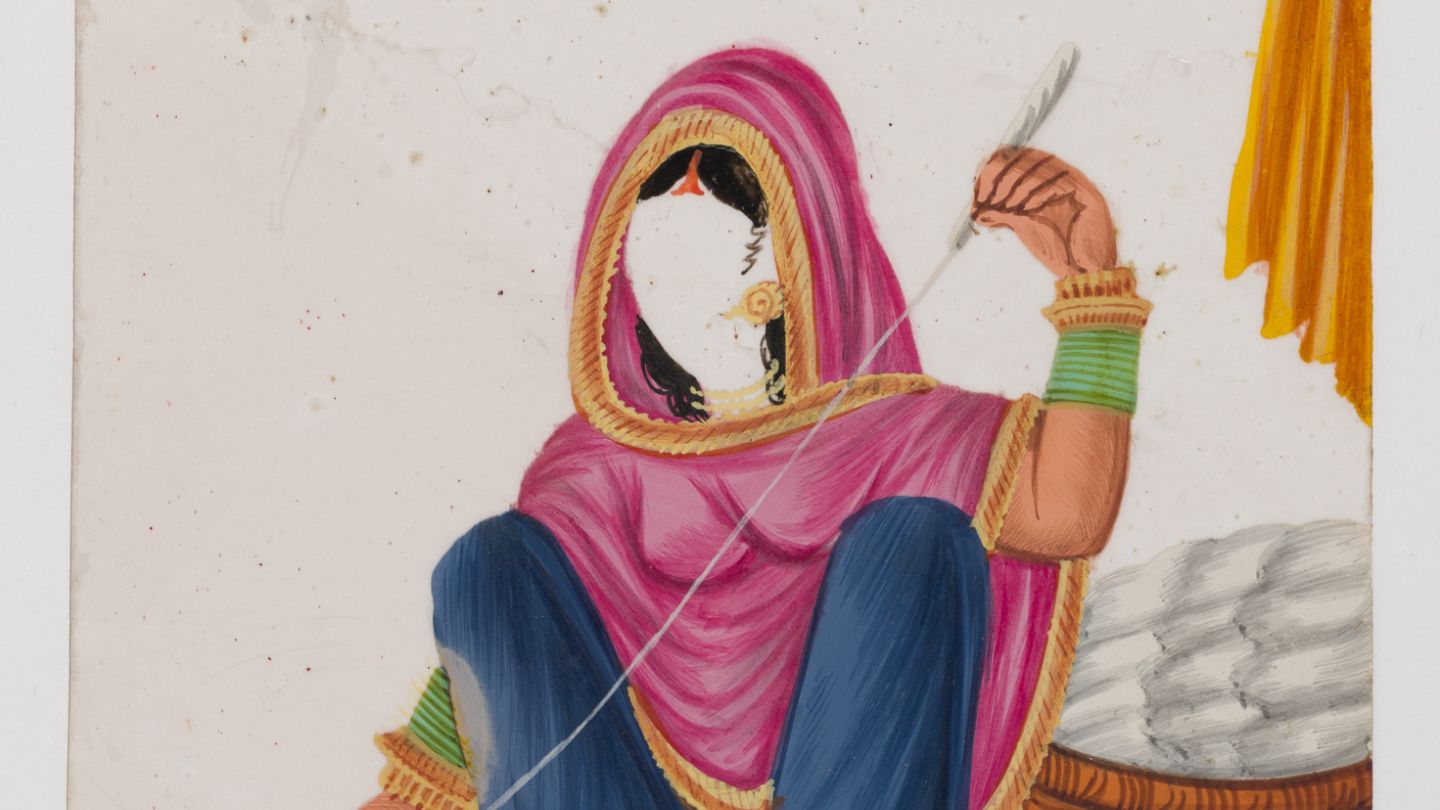
Online Talk
In Search of Knowledge and Riches
Dr. Annamma Spudich
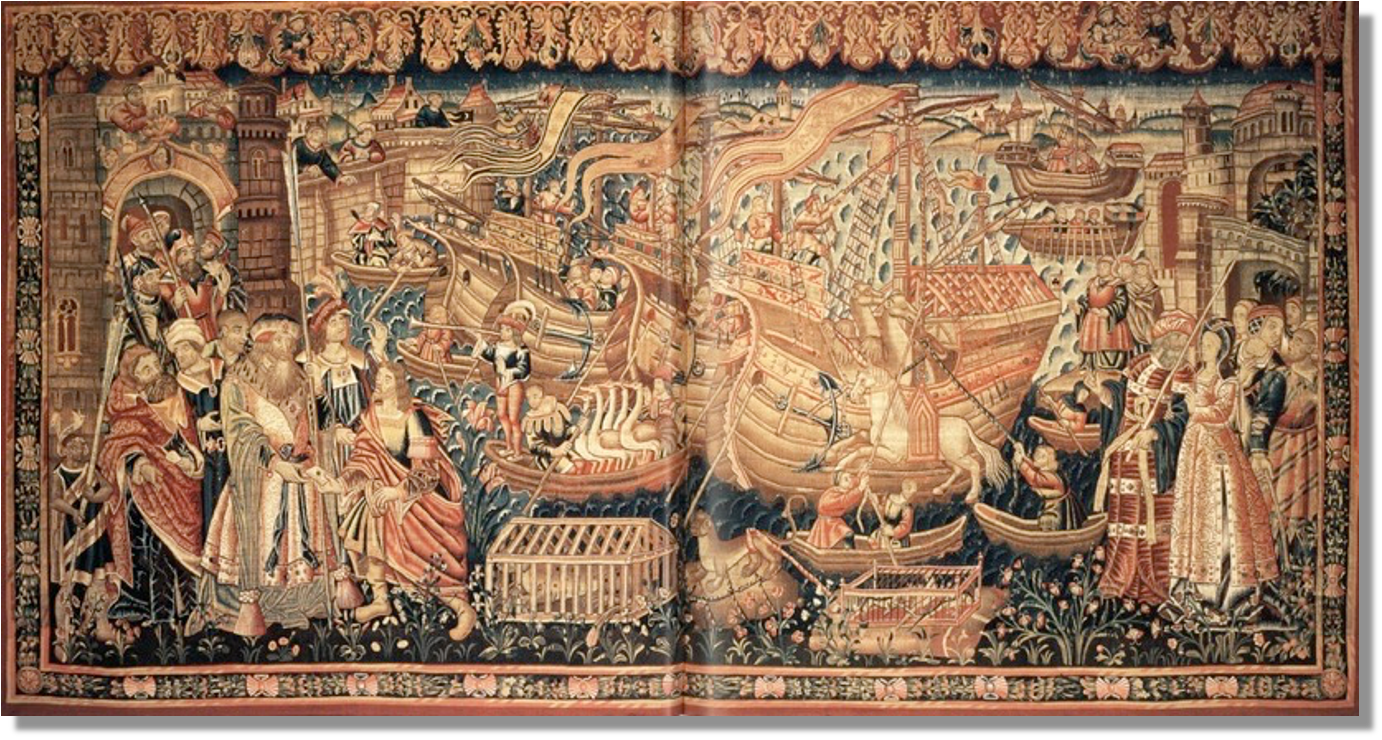
Image credits: Voyage to Calicut Series, Tapestry, Silk and Wool, 1504, Portuguese National Library, Lisbon
For centuries India was the nexus of a global trade in spices, medicines, dyes, unguents and perfumes—high‑value goods whose value rested on deep, native knowledge of plants and healing. In this online talk, renowned researcher Dr. Annamma Spudich traces how archaeological finds and trade records from the first millennium onwards reveal India’s sophisticated botanical and medical systems, and why by the Middle Ages “India trade was the backbone of the international economy.”
Learn how the late‑15th‑century European search for direct sea routes brought Spain, Portugal, and later the Dutch and British, into India, and how, finding their own medical knowledge inadequate for the tropics, turned to Indian physicians and botanical expertise. Dr Spudich will examine these European documents from the 16th–19th centuries that recorded Indian medicinal, agricultural and horticultural knowledge, and show how these encounters broadened Western science, inspired artists and poets and reshaped global history.
This online talk is in conjunction with MAP’s ongoing exhibition, Paper Gardens: Art, Botany and Empire, bringing together over a hundred botanical illustrations, tracing encounters between plants, artists, and institutions, and reanimating the networks of labour and imagination that have built our understanding of the natural world.

Dr. Annamma Spudich
Annamma Spudich did her PhD and postdoctoral work in molecular cell biology at Stanford University and was a biomedical researcher in academic and drug discovery settings. In 2000 she left basic science research to devote her intellectual energies to her lifelong interest in the scholar physicians of Indian traditional medicine; the history and impact of Indian knowledge in the natural sciences and medicine on global trade since the first millennium; the scientific knowledge development in botany and medicine; and the role of assimilation of Indian botanical medical knowledge on the European colonial enterprises in India. Her work has brought to light important material on the subjects that has been featured in exhibitions she curated at the Cantor Center for Visual Arts, Stanford University in 2003, the National Center for Biological Sciences, in 2008 and 2017, the Visvesvaraya Industrial & Technological Museum Bangalore in 2023, and the International Ayurveda Conference, Leiden in 2019. Spudich is the author of several scientific papers and the catalog that accompanied the NCBS exhibition. She has lectured at universities and museums around the world. A summary of her work is featured in an online exhibition for the Google Cultural Institute. She was a visiting scholar/faculty at the NCBS/TIFR, Bangalore from 2005 to 2022.